
How it works
The cash flow is the list of money in and out by year. Write that list first.
- Add the rent you will pay. Subtract the credits you treat as rent relief.
- Divide by the years or the occupied months you chose.
- Say what you put in. Say what you left out.
- Then, if timing matters, also show NPV.
Formula in words. Effective rent ≈ (rent over the term − credits you spread) / years you chose to divide by.
| Input | Meaning |
|---|---|
| Rent path | The actual rent by year |
| Credits in the average | What you chose to spread |
| Divisor | Years or months |
Worked example
Here is a teaching sample. It is not customer data and not a result from a live client.
| Metric | Lease A | Lease B |
|---|---|---|
| Start rent | $37,000 | $34,410 |
| Year-1 extras | $9,000 | $9,630 |
| Year-1 credit | $10,000 | $5,500 |
| Sample NPV | $338,047 | $327,414 |
| Year | Rent | Extras | Credit | Cash out | Value today |
|---|---|---|---|---|---|
| Year 1 | $37,000 | $9,000 | $10,000 | $36,000 | $33,333 |
| Year 2 | $38,110 | $9,270 | $0 | $47,380 | $40,621 |
| Year 3 | $39,253 | $9,548 | $0 | $48,801 | $38,740 |
| Year 4 | $40,431 | $9,835 | $0 | $50,266 | $36,947 |
| Year 5 | $41,644 | $10,130 | $0 | $51,774 | $35,237 |
| Year 6 | $42,893 | $10,434 | $0 | $53,327 | $33,605 |
| Year 7 | $44,180 | $10,747 | $0 | $54,927 | $32,049 |
| Year 8 | $45,505 | $11,069 | $0 | $56,574 | $30,565 |
| Year 9 | $46,870 | $11,401 | $0 | $58,271 | $29,150 |
| Year 10 | $48,276 | $11,743 | $0 | $60,019 | $27,800 |
| Sample NPV | — | — | — | — | $338,047 |
How to read the sample
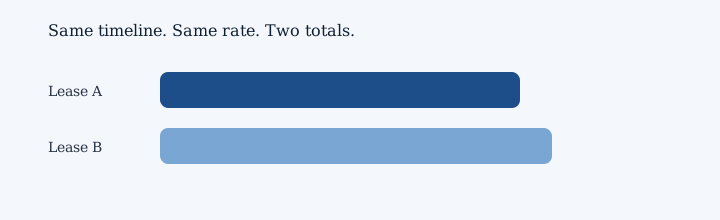
Sample NPV for the averaged lease is about $338,047. A second path lands near $327,414. That gap is a talking point, not a promise.
The average would smear this credit. If one path wins only because a credit sat in the wrong year, start over.
Year notes for the averaged lease
- Year 1 of the averaged lease has rent of $37,000.
- Shared building cost is $9,000.
- A credit of $10,000 lowers the cash you pay that year.
- Cash out this year is about $36,000. The average would smear this credit.
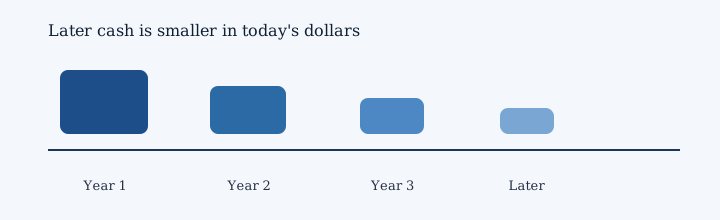
- Later cash gets a shrink for time. At 8 percent, year 1 is worth about $33,333 today.
- Next, year 2 rent is $38,110.
- CAM, which is a shared building cost, is $9,270.
- There is no credit in this year.
- You pay about $47,380 this year after extras and credits. NPV would keep this year heavier after the gift.
- Time shrinks later cash. At 8 percent, year 2 is worth about $40,621 today.
- Then year 3 rent is $39,253.
- Extras for the building come to $9,548.
- Credits skip this year.
- The net cash this year is about $48,801. Steps still sit in the path.
- Waiting has a price. At 8 percent, year 3 is worth about $38,740 today.
- After that, year 4 rent is $40,431.
- The shared building cost this time is $9,835.
- No extra credit shows up this year.
- Cash out this year is about $50,266. An average can look calm while this year jumps.
- Later cash gets a shrink for time. At 8 percent, year 4 is worth about $36,947 today.
- In year 5 of the averaged lease, rent is $41,644.
- Shared building cost is $10,130.
- There is no credit in this year.
- You pay about $51,774 this year after extras and credits. The last year is why averages lie softly.
- Time shrinks later cash. At 8 percent, year 5 is worth about $35,237 today.
- Year 6 of the averaged lease has rent of $42,893.
- CAM, which is a shared building cost, is $10,434.
- Credits skip this year.
- The net cash this year is about $53,327. Keep this later year in the sum for the sample.
- Waiting has a price. At 8 percent, year 6 is worth about $33,605 today.
- Next, year 7 rent is $44,180.
- Extras for the building come to $10,747.
- No extra credit shows up this year.
- Cash out this year is about $54,927. The row still belongs in the sum for the long path.
- Later cash gets a shrink for time. At 8 percent, year 7 is worth about $32,049 today.
- Then year 8 rent is $45,505.
- The shared building cost this time is $11,069.
- There is no credit in this year.
- You pay about $56,574 this year after extras and credits. Keep this later year in the sum for the long path.
- Time shrinks later cash. At 8 percent, year 8 is worth about $30,565 today.
- After that, year 9 rent is $46,870.
- Shared building cost is $11,401.
- Credits skip this year.
- The net cash this year is about $58,271. The row still belongs in the sum for the long path.
- Waiting has a price. At 8 percent, year 9 is worth about $29,150 today.
- In year 10 of the averaged lease, rent is $48,276.
- CAM, which is a shared building cost, is $11,743.
- No extra credit shows up this year.
- Cash out this year is about $60,019. Keep this later year in the sum for the long path.
- Later cash gets a shrink for time. At 8 percent, year 10 is worth about $27,800 today.
Add those year values. The sample NPV for the averaged lease is about $338,047. This is a teaching sample, not a client result.
Questions this topic answers
These are the standalone authority pages in this family. They are grouped so a reader can start, calculate, compare, or go deeper without a wall of cards.
Start here
Calculate it
Compare options
Common mistakes
Trusted sources
These are public references. They are not endorsements and not client results.
How to use this with OccupancyNPV
This page answers the concept. OccupancyNPV applies it inside a DealWorkspace: enter lease scenarios, review cash-flow and occupancy cost, then compare NPV and discount-rate sensitivity. OccupancyNPV NPV is not the same as a face-rent comparison. OccupancyNPV is not a CRM or lease-administration suite, and this page is not legal or investment advice.
Next: start the 3-day free trial, open pricing, or continue through related product paths.