

How it works
The cash flow is the list of money in and out by year. Write that list first.
- Build one cash list.
- Make the average from that list if you need a headline.
- Make the NPV from the same list with a visible rate.
- If the rank differs, say why. It is usually timing.
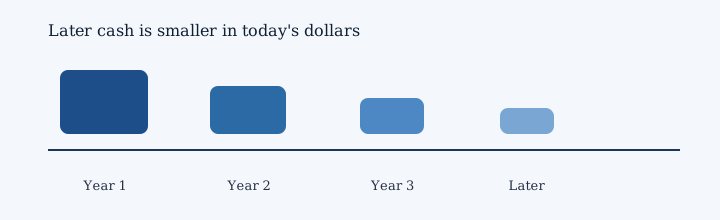
Formula in words. Average = flatten. NPV = shrink later years, then add.
| Input | Meaning |
|---|---|
| Same cash list | Do not switch inputs between tools |
| Average rule | What you spread |
| NPV rate | How you shrink |
Worked example
Here is a teaching sample. It is not customer data and not a result from a live client.
| Metric | Lease A | Lease B |
|---|---|---|
| Start rent | $40,000 | $37,200 |
| Year-1 extras | $8,800 | $9,416 |
| Year-1 credit | $16,000 | $8,800 |
| Sample NPV | $366,312 | $355,601 |
| Year | Rent | Extras | Credit | Cash out | Value today |
|---|---|---|---|---|---|
| Year 1 | $40,000 | $8,800 | $16,000 | $32,800 | $30,370 |
| Year 2 | $41,800 | $9,064 | $0 | $50,864 | $43,608 |
| Year 3 | $43,681 | $9,336 | $0 | $53,017 | $42,087 |
| Year 4 | $45,647 | $9,616 | $0 | $55,263 | $40,620 |
| Year 5 | $47,701 | $9,904 | $0 | $57,605 | $39,205 |
| Year 6 | $49,132 | $10,201 | $0 | $59,333 | $37,390 |
| Year 7 | $50,606 | $10,507 | $0 | $61,113 | $35,659 |
| Year 8 | $52,124 | $10,822 | $0 | $62,946 | $34,008 |
| Year 9 | $53,688 | $11,147 | $0 | $64,835 | $32,434 |
| Year 10 | $55,299 | $11,481 | $0 | $66,780 | $30,932 |
| Sample NPV | — | — | — | — | $366,312 |
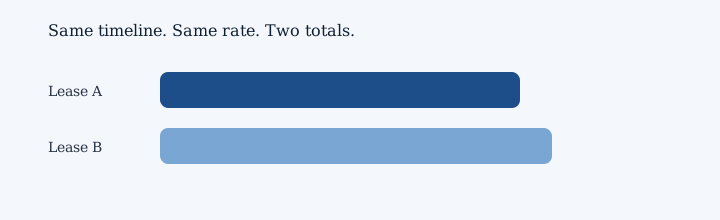
How to read the sample
Sample NPV for the contrast lease is about $366,312. A second path lands near $355,601. That gap is a talking point, not a promise.
An early credit boosts both tools, but NPV more. If one path wins only because a credit sat in the wrong year, start over.
Year notes for the contrast lease
- Year 1 of the contrast lease has rent of $40,000.
- Shared building cost is $8,800.
- A credit of $16,000 lowers the cash you pay that year.
- Cash out this year is about $32,800. An early credit boosts both tools, but NPV more.
- Later cash gets a shrink for time. At 8 percent, year 1 is worth about $30,370 today.
- Next, year 2 rent is $41,800.
- CAM, which is a shared building cost, is $9,064.
- There is no credit in this year.
- You pay about $50,864 this year after extras and credits. The average already smeared the gift.
- Time shrinks later cash. At 8 percent, year 2 is worth about $43,608 today.
- Then year 3 rent is $43,681.
- Extras for the building come to $9,336.
- Credits skip this year.
- The net cash this year is about $53,017. Steps hurt the average less than they hurt undiscounted totals.
- Waiting has a price. At 8 percent, year 3 is worth about $42,087 today.
- After that, year 4 rent is $45,647.
- The shared building cost this time is $9,616.
- No extra credit shows up this year.
- Cash out this year is about $55,263. NPV still sees later weight if the rate is modest.
- Later cash gets a shrink for time. At 8 percent, year 4 is worth about $40,620 today.
- In year 5 of the contrast lease, rent is $47,701.
- Shared building cost is $9,904.
- There is no credit in this year.
- You pay about $57,605 this year after extras and credits. This last year is where the two tools can disagree.
- Time shrinks later cash. At 8 percent, year 5 is worth about $39,205 today.
- Year 6 of the contrast lease has rent of $49,132.
- CAM, which is a shared building cost, is $10,201.
- Credits skip this year.
- The net cash this year is about $59,333. Keep this later year in the sum for the sample.
- Waiting has a price. At 8 percent, year 6 is worth about $37,390 today.
- Next, year 7 rent is $50,606.
- Extras for the building come to $10,507.
- No extra credit shows up this year.
- Cash out this year is about $61,113. The row still belongs in the sum for the long path.
- Later cash gets a shrink for time. At 8 percent, year 7 is worth about $35,659 today.
- Then year 8 rent is $52,124.
- The shared building cost this time is $10,822.
- There is no credit in this year.
- You pay about $62,946 this year after extras and credits. Keep this later year in the sum for the long path.
- Time shrinks later cash. At 8 percent, year 8 is worth about $34,008 today.
- After that, year 9 rent is $53,688.
- Shared building cost is $11,147.
- Credits skip this year.
- The net cash this year is about $64,835. The row still belongs in the sum for the long path.
- Waiting has a price. At 8 percent, year 9 is worth about $32,434 today.
- In year 10 of the contrast lease, rent is $55,299.
- CAM, which is a shared building cost, is $11,481.
- No extra credit shows up this year.
- Cash out this year is about $66,780. Keep this later year in the sum for the long path.
- Later cash gets a shrink for time. At 8 percent, year 10 is worth about $30,932 today.
Add those year values. The sample NPV for the contrast lease is about $366,312. This is a teaching sample, not a client result.
Trusted sources
These are public references. They are not endorsements and not client results.
How to use this with OccupancyNPV
This page answers the concept. OccupancyNPV applies it inside a DealWorkspace: enter lease scenarios, review cash-flow and occupancy cost, then compare NPV and discount-rate sensitivity. OccupancyNPV NPV is not the same as a face-rent comparison. OccupancyNPV is not a CRM or lease-administration suite, and this page is not legal or investment advice.
Next: start the 3-day free trial, open pricing, or continue through related product paths.