

How it works
Write the cash list first. Then decide what the page is measuring.
- Line up identity: size, dates, term, type.
- Fill money lines from the sketch and from questions.
- Mark every unknown.
- Normalize what you can.
- Do not rank on unknown extras.
Formula in words. LOI compare = rebuilt stacks + unknown list + next questions.
| Input | Meaning |
|---|---|
| LOI rent | The sketch sticker |
| Lease type | Gross, modified, or net |
| Credits | If stated |
| Unknowns | What the sketch skipped |
Worked example
Here is a teaching sample. It is not customer data and not a result from a live client.
| Metric | Lease A | Lease B |
|---|---|---|
| Start rent | $38,500 | $35,805 |
| Year-1 extras | $10,500 | $11,235 |
| Year-1 credit | $10,000 | $5,500 |
| Sample NPV | $360,698 | $350,067 |
| Year | Rent | Extras | Credit | Cash out | Value today |
|---|---|---|---|---|---|
| Year 1 | $38,500 | $10,500 | $10,000 | $39,000 | $36,111 |
| Year 2 | $39,655 | $10,815 | $0 | $50,470 | $43,270 |
| Year 3 | $40,845 | $11,139 | $0 | $51,984 | $41,267 |
| Year 4 | $42,070 | $11,474 | $0 | $53,544 | $39,356 |
| Year 5 | $43,332 | $11,818 | $0 | $55,150 | $37,534 |
| Year 6 | $44,632 | $12,173 | $0 | $56,805 | $35,797 |
| Year 7 | $45,971 | $12,538 | $0 | $58,509 | $34,139 |
| Year 8 | $47,350 | $12,914 | $0 | $60,264 | $32,559 |
| Year 9 | $48,771 | $13,301 | $0 | $62,072 | $31,051 |
| Year 10 | $50,234 | $13,700 | $0 | $63,934 | $29,614 |
| Sample NPV | — | — | — | — | $360,698 |
How to read the sample
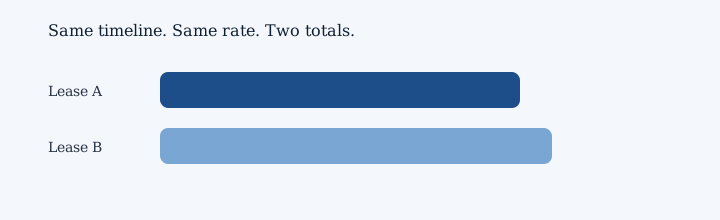
Sample NPV for LOI-rebuild sample is about $360,698. A second path lands near $350,067. That gap is a talking point, not a promise.
Year notes for LOI-rebuild sample
- Year 1 of LOI-rebuild sample has rent of $38,500.
- Shared building cost is $10,500.
- A credit of $10,000 lowers the cash you pay that year.
- Cash out this year is about $39,000. The sketch promised a credit here.
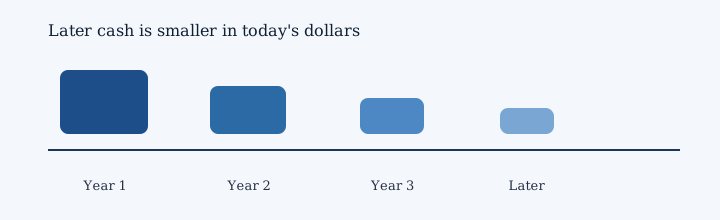
- Later cash gets a shrink for time. At 8 percent, year 1 is worth about $36,111 today.
- Next, year 2 rent is $39,655.
- CAM, which is a shared building cost, is $10,815.
- There is no credit in this year.
- You pay about $50,470 this year after extras and credits. Year two is where skipped extras appear.
- Time shrinks later cash. At 8 percent, year 2 is worth about $43,270 today.
- Then year 3 rent is $40,845.
- Extras for the building come to $11,139.
- Credits skip this year.
- The net cash this year is about $51,984. The bump may not even be in the LOI.
- Waiting has a price. At 8 percent, year 3 is worth about $41,267 today.
- After that, year 4 rent is $42,070.
- The shared building cost this time is $11,474.
- No extra credit shows up this year.
- Cash out this year is about $53,544. Later years are guesswork until the lease draft arrives.
- Later cash gets a shrink for time. At 8 percent, year 4 is worth about $39,356 today.
- In year 5 of LOI-rebuild sample, rent is $43,332.
- Shared building cost is $11,818.
- There is no credit in this year.
- You pay about $55,150 this year after extras and credits. The last year still needs a stated term.
- Time shrinks later cash. At 8 percent, year 5 is worth about $37,534 today.
- Year 6 of LOI-rebuild sample has rent of $44,632.
- CAM, which is a shared building cost, is $12,173.
- Credits skip this year.
- The net cash this year is about $56,805. Keep this later year in the sum for the sample.
- Waiting has a price. At 8 percent, year 6 is worth about $35,797 today.
- Next, year 7 rent is $45,971.
- Extras for the building come to $12,538.
- No extra credit shows up this year.
- Cash out this year is about $58,509. The row still belongs in the sum for the long path.
- Later cash gets a shrink for time. At 8 percent, year 7 is worth about $34,139 today.
- Then year 8 rent is $47,350.
- The shared building cost this time is $12,914.
- There is no credit in this year.
- You pay about $60,264 this year after extras and credits. Keep this later year in the sum for the long path.
- Time shrinks later cash. At 8 percent, year 8 is worth about $32,559 today.
- After that, year 9 rent is $48,771.
- Shared building cost is $13,301.
- Credits skip this year.
- The net cash this year is about $62,072. The row still belongs in the sum for the long path.
- Waiting has a price. At 8 percent, year 9 is worth about $31,051 today.
- In year 10 of LOI-rebuild sample, rent is $50,234.
- CAM, which is a shared building cost, is $13,700.
- No extra credit shows up this year.
- Cash out this year is about $63,934. Keep this later year in the sum for the long path.
- Later cash gets a shrink for time. At 8 percent, year 10 is worth about $29,614 today.
Add those year values. The sample NPV for LOI-rebuild sample is about $360,698. This is a teaching sample, not a client result.
Trusted sources
These are public references. They are not endorsements and not client results.
How to use this with OccupancyNPV
This page answers the concept. OccupancyNPV applies it inside a DealWorkspace: enter lease scenarios, review cash-flow and occupancy cost, then compare NPV and discount-rate sensitivity. OccupancyNPV NPV is not the same as a face-rent comparison. OccupancyNPV is not a CRM or lease-administration suite, and this page is not legal or investment advice.
Next: start the 3-day free trial, open pricing, or continue through related product paths.