
How it works
Write the cash list first. Then decide what the page is measuring.
- Ask for extra history, not a single CAM quote.
- Ask what happens after a sale.
- Ask who pays parking and after-hours HVAC.
- Put move costs on a side list if they change the stay-versus-move pick.
Formula in words. Hidden add = tax delta + insurance delta + CAM true-up + parking + leftover build-out.
| Input | Meaning |
|---|---|
| Tax history | And reassessment risk |
| Insurance | Trend, not one year |
| CAM true-up | Estimate versus actual |
| Move-in | Furniture, move, leftover TI |
Worked example
Here is a teaching sample. It is not customer data and not a result from a live client.
Lease A start rent$27,500
Lease B start rent$25,575
Discount rate8%
Sample NPV A$324,745
| Metric | Lease A | Lease B |
|---|---|---|
| Start rent | $27,500 | $25,575 |
| Year-1 extras | $15,500 | $16,585 |
| Year-1 credit | $3,000 | $1,650 |
| Sample NPV | $324,745 | $319,452 |
| Year | Rent | Extras | Credit | Cash out | Value today |
|---|---|---|---|---|---|
| Year 1 | $27,500 | $15,500 | $3,000 | $40,000 | $37,037 |
| Year 2 | $28,462 | $15,965 | $0 | $44,427 | $38,089 |
| Year 3 | $29,459 | $16,444 | $0 | $45,903 | $36,439 |
| Year 4 | $30,490 | $16,937 | $0 | $47,427 | $34,860 |
| Year 5 | $31,557 | $17,445 | $0 | $49,002 | $33,350 |
| Year 6 | $32,504 | $17,968 | $0 | $50,472 | $31,806 |
| Year 7 | $33,479 | $18,507 | $0 | $51,986 | $30,333 |
| Year 8 | $34,483 | $19,062 | $0 | $53,545 | $28,929 |
| Year 9 | $35,517 | $19,634 | $0 | $55,151 | $27,589 |
| Year 10 | $36,583 | $20,223 | $0 | $56,806 | $26,312 |
| Sample NPV | — | — | — | — | $324,745 |
How to read the sample
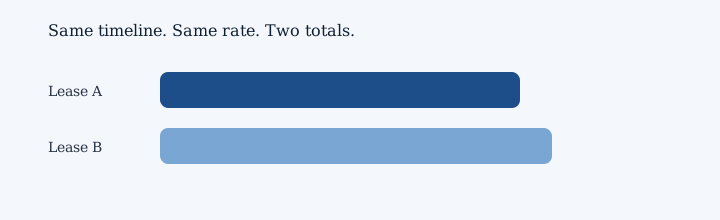
Sample NPV for Hidden-cost sample is about $324,745. A second path lands near $319,452. That gap is a talking point, not a promise.
Year notes for Hidden-cost sample
- Year 1 of Hidden-cost sample has rent of $27,500.
- Shared building cost is $15,500.
- A credit of $3,000 lowers the cash you pay that year.
- Cash out this year is about $40,000. Year one looks calm until extras land.
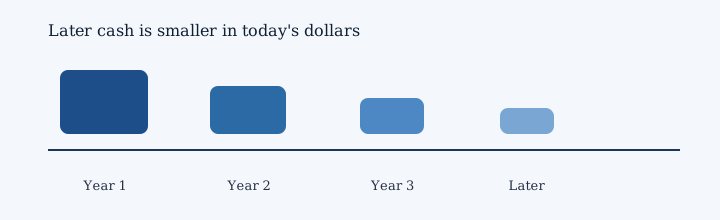
- Later cash gets a shrink for time. At 8 percent, year 1 is worth about $37,037 today.
- Next, year 2 rent is $28,462.
- CAM, which is a shared building cost, is $15,965.
- There is no credit in this year.
- You pay about $44,427 this year after extras and credits. A tax step can sit in year two.
- Time shrinks later cash. At 8 percent, year 2 is worth about $38,089 today.
- Then year 3 rent is $29,459.
- Extras for the building come to $16,444.
- Credits skip this year.
- The net cash this year is about $45,903. Insurance can jump without a rent bump.
- Waiting has a price. At 8 percent, year 3 is worth about $36,439 today.
- After that, year 4 rent is $30,490.
- The shared building cost this time is $16,937.
- No extra credit shows up this year.
- Cash out this year is about $47,427. Later years keep the extra stack.
- Later cash gets a shrink for time. At 8 percent, year 4 is worth about $34,860 today.
- In year 5 of Hidden-cost sample, rent is $31,557.
- Shared building cost is $17,445.
- There is no credit in this year.
- You pay about $49,002 this year after extras and credits. The last year is not a sticker year.
- Time shrinks later cash. At 8 percent, year 5 is worth about $33,350 today.
- Year 6 of Hidden-cost sample has rent of $32,504.
- CAM, which is a shared building cost, is $17,968.
- Credits skip this year.
- The net cash this year is about $50,472. Keep this later year in the sum for the sample.
- Waiting has a price. At 8 percent, year 6 is worth about $31,806 today.
- Next, year 7 rent is $33,479.
- Extras for the building come to $18,507.
- No extra credit shows up this year.
- Cash out this year is about $51,986. The row still belongs in the sum for the long path.
- Later cash gets a shrink for time. At 8 percent, year 7 is worth about $30,333 today.
- Then year 8 rent is $34,483.
- The shared building cost this time is $19,062.
- There is no credit in this year.
- You pay about $53,545 this year after extras and credits. Keep this later year in the sum for the long path.
- Time shrinks later cash. At 8 percent, year 8 is worth about $28,929 today.
- After that, year 9 rent is $35,517.
- Shared building cost is $19,634.
- Credits skip this year.
- The net cash this year is about $55,151. The row still belongs in the sum for the long path.
- Waiting has a price. At 8 percent, year 9 is worth about $27,589 today.
- In year 10 of Hidden-cost sample, rent is $36,583.
- CAM, which is a shared building cost, is $20,223.
- No extra credit shows up this year.
- Cash out this year is about $56,806. Keep this later year in the sum for the long path.
- Later cash gets a shrink for time. At 8 percent, year 10 is worth about $26,312 today.
Add those year values. The sample NPV for Hidden-cost sample is about $324,745. This is a teaching sample, not a client result.
Trusted sources
These are public references. They are not endorsements and not client results.