
How it works
Write the cash list first. Then decide what the page is measuring.
- Ask for the extra list, not a single CAM number.
- Ask what is excluded.
- Ask whether a controllable cap exists.
- Place the estimate and the true-up on the timeline.
Formula in words. CAM share = building CAM pool × tenant percent. Then true up to actuals.
| Input | Meaning |
|---|---|
| CAM estimate | Monthly extra |
| Tenant share | Percent of the building |
| Exclusions | What the tenant should not pay |
| Cap | Limit on controllable extras |
Worked example
Here is a teaching sample. It is not customer data and not a result from a live client.
Lease A start rent$26,000
Lease B start rent$24,180
Discount rate8%
Sample NPV A$298,301
| Metric | Lease A | Lease B |
|---|---|---|
| Start rent | $26,000 | $24,180 |
| Year-1 extras | $14,000 | $14,980 |
| Year-1 credit | $4,000 | $2,200 |
| Sample NPV | $298,301 | $293,626 |
| Year | Rent | Extras | Credit | Cash out | Value today |
|---|---|---|---|---|---|
| Year 1 | $26,000 | $14,000 | $4,000 | $36,000 | $33,333 |
| Year 2 | $26,780 | $14,420 | $0 | $41,200 | $35,322 |
| Year 3 | $27,583 | $14,853 | $0 | $42,436 | $33,687 |
| Year 4 | $28,411 | $15,298 | $0 | $43,709 | $32,127 |
| Year 5 | $29,263 | $15,757 | $0 | $45,020 | $30,640 |
| Year 6 | $30,141 | $16,230 | $0 | $46,371 | $29,222 |
| Year 7 | $31,045 | $16,717 | $0 | $47,762 | $27,869 |
| Year 8 | $31,976 | $17,219 | $0 | $49,195 | $26,579 |
| Year 9 | $32,935 | $17,736 | $0 | $50,671 | $25,348 |
| Year 10 | $33,923 | $18,268 | $0 | $52,191 | $24,175 |
| Sample NPV | — | — | — | — | $298,301 |
How to read the sample
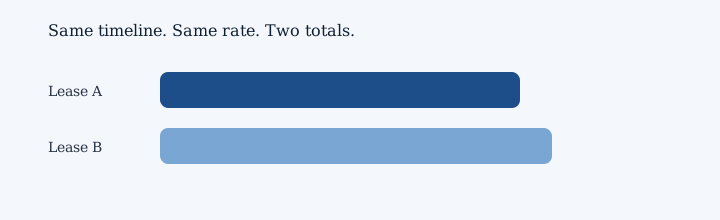
Sample NPV for CAM sample is about $298,301. A second path lands near $293,626. That gap is a talking point, not a promise.
Year notes for CAM sample
- Year 1 of CAM sample has rent of $26,000.
- Shared building cost is $14,000.
- A credit of $4,000 lowers the cash you pay that year.
- Cash out this year is about $36,000. CAM is the large extra in year one.
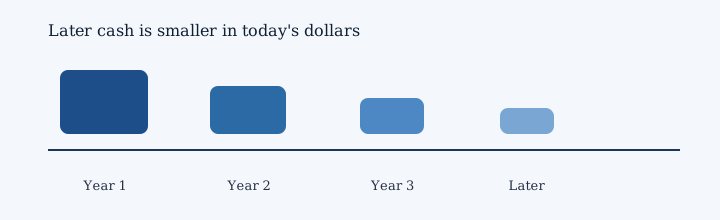
- Later cash gets a shrink for time. At 8 percent, year 1 is worth about $33,333 today.
- Next, year 2 rent is $26,780.
- CAM, which is a shared building cost, is $14,420.
- There is no credit in this year.
- You pay about $41,200 this year after extras and credits. The estimate steps with the building.
- Time shrinks later cash. At 8 percent, year 2 is worth about $35,322 today.
- Then year 3 rent is $27,583.
- Extras for the building come to $14,853.
- Credits skip this year.
- The net cash this year is about $42,436. A true-up would land as a short extra credit or bill.
- Waiting has a price. At 8 percent, year 3 is worth about $33,687 today.
- After that, year 4 rent is $28,411.
- The shared building cost this time is $15,298.
- No extra credit shows up this year.
- Cash out this year is about $43,709. Later years still carry the pool.
- Later cash gets a shrink for time. At 8 percent, year 4 is worth about $32,127 today.
- In year 5 of CAM sample, rent is $29,263.
- Shared building cost is $15,757.
- There is no credit in this year.
- You pay about $45,020 this year after extras and credits. The last year still needs a CAM line.
- Time shrinks later cash. At 8 percent, year 5 is worth about $30,640 today.
- Year 6 of CAM sample has rent of $30,141.
- CAM, which is a shared building cost, is $16,230.
- Credits skip this year.
- The net cash this year is about $46,371. Keep this later year in the sum for the sample.
- Waiting has a price. At 8 percent, year 6 is worth about $29,222 today.
- Next, year 7 rent is $31,045.
- Extras for the building come to $16,717.
- No extra credit shows up this year.
- Cash out this year is about $47,762. The row still belongs in the sum for the long path.
- Later cash gets a shrink for time. At 8 percent, year 7 is worth about $27,869 today.
- Then year 8 rent is $31,976.
- The shared building cost this time is $17,219.
- There is no credit in this year.
- You pay about $49,195 this year after extras and credits. Keep this later year in the sum for the long path.
- Time shrinks later cash. At 8 percent, year 8 is worth about $26,579 today.
- After that, year 9 rent is $32,935.
- Shared building cost is $17,736.
- Credits skip this year.
- The net cash this year is about $50,671. The row still belongs in the sum for the long path.
- Waiting has a price. At 8 percent, year 9 is worth about $25,348 today.
- In year 10 of CAM sample, rent is $33,923.
- CAM, which is a shared building cost, is $18,268.
- No extra credit shows up this year.
- Cash out this year is about $52,191. Keep this later year in the sum for the long path.
- Later cash gets a shrink for time. At 8 percent, year 10 is worth about $24,175 today.
Add those year values. The sample NPV for CAM sample is about $298,301. This is a teaching sample, not a client result.
Trusted sources
These are public references. They are not endorsements and not client results.