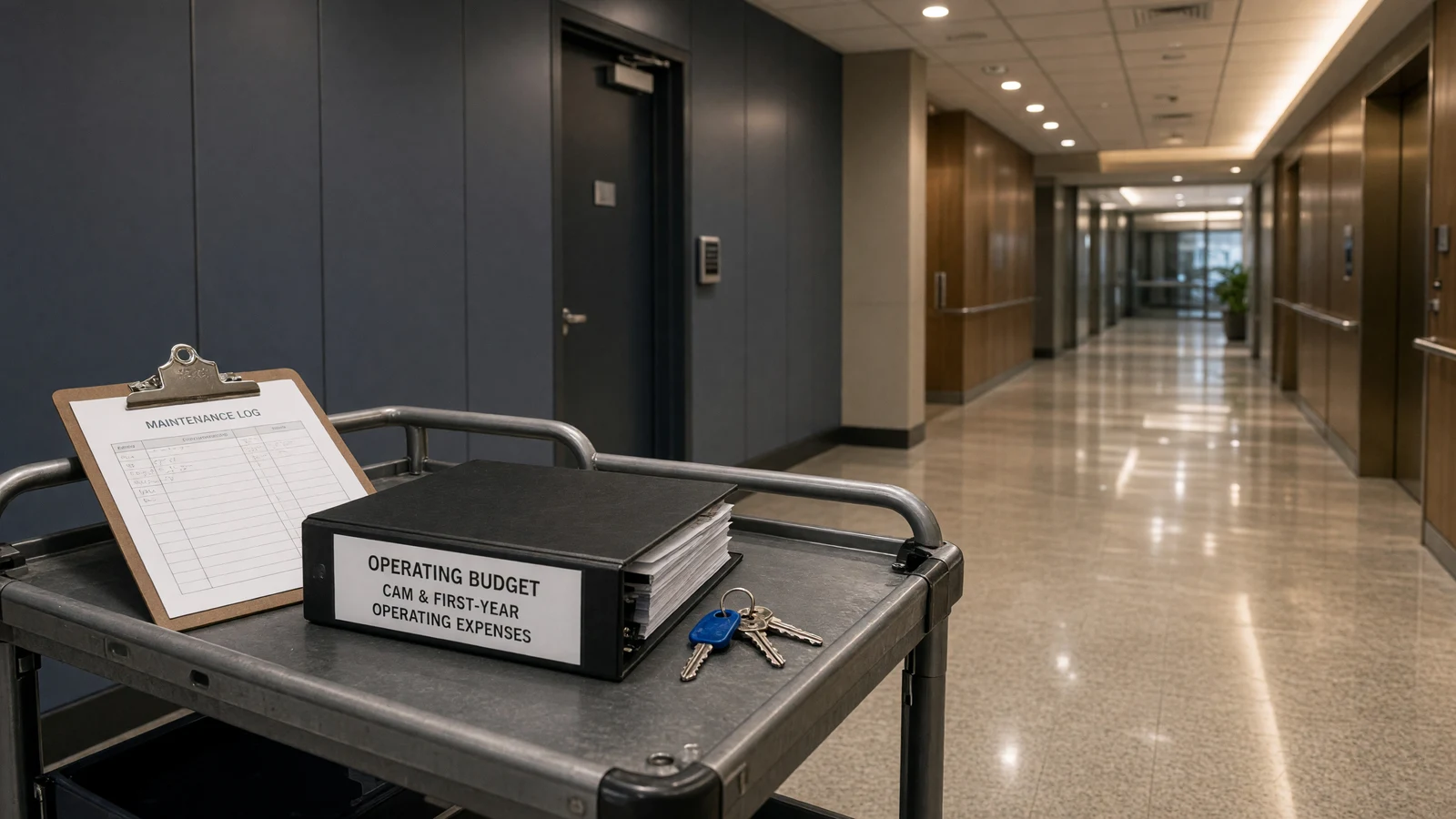
What first-year CAM is—and is not
How should a tenant treat CAM in the first operating year? Start by treating the number as a labeled occupancy-cost estimate on the same timeline as rent. First-year CAM is projected versus reconciled; it is not a finished bill. Copy the lease language before you compare face rent.
Common area maintenance (CAM) pays for shared operating costs—hallways, lobbies, landscaping, common utilities, and similar lines defined in the lease. In year one you often receive a CAM estimate: a budget for the operating year. Estimated CAM is not the same as reconciled CAM after actual expenses are known. Label which you are holding.
An expense stop versus a base-year comparison changes who pays the overrun. The estimate is a budget. A stop is a ceiling on the tenant share. A base-year comparison starts from a documented operating-expense year and bills overages from that baseline. Use an occupancy-cost table so those three ideas do not collapse into one cell named CAM.
Estimate, expense stop, and base year
Is first-year CAM the same as the final CAM bill? No. You may reconcile later when the landlord sends a statement of actuals. Until then, label it as projected occupancy-cost cash, not a closed number.
Build an occupancy-cost table beside rent. CAM equals PSF times rentable SF. Lease A might show $8,000 monthly rent and $14 CAM per square foot on 4,000 rentable square feet. CAM cash is $56,000 for a full year. Year-one occupancy cash is $96,000 of rent plus $56,000 of CAM, or $152,000. Lease B might show $7,400 monthly rent and $18 CAM, or $72,000 of CAM. Year-one occupancy cash is $88,800 plus $72,000, or $160,800. Lower rent did not win year one when CAM was higher.
Estimate versus stop versus base year belongs in a small table on your worksheet: row one is the CAM estimate (budget), row two is the expense stop if the lease uses one, row three is the base-year reference if recoveries compare to a documented year. Keep projected versus reconciled labels on the same page as rent.
Put CAM on the occupancy-cost timeline
Stub-year cash matters when mid-year occupancy means you are not paying twelve months. If occupancy starts in September, a $56,000 full-year estimate might represent about $18,667 of stub-year cash, not $56,000 in the first calendar window. Do not annualize a stub and call it year one.
At reconciliation, a reconciliation deficit appears when actual common-area expenses exceed the estimate. Who pays a deficit is a lease question—read the clause. Demand the backup: the prior-year reconciliation statement, the included-expenses list, invoices for the largest lines, and the CAM budget worksheet before you pay a catch-up bill.
A vacant-building gross-up can inflate first-year CAM as if the building were fuller than it is. A CAM cap can limit the tenant share. Utilities versus CAM and other separately billed lines stay off the CAM cell unless the lease puts them there. Copy the included-expenses list before you merge cells.
Compare two leases when CAM differs
What first-year CAM typically includes versus excludes: it typically includes janitorial, common-area utilities, landscaping, and routine common-area repairs when the lease puts them in the CAM pool. It typically excludes capital replacements such as a new roof, separately metered tenant utilities, and insurance or tax lines the lease bills on their own.
How do landlords estimate first-year CAM? Landlord estimates usually start from prior-year actuals, then adjust for known contracts and budget changes. If the packet has no prior-year actuals, treat the figure as weak. Request the CAM budget worksheet and last year’s backup.
Controllable expenses—janitorial contracts, landscaping bids—can be renegotiated. Uncontrollable items such as property taxes move with the jurisdiction. A tenant who cannot separate controllable from uncontrollable cannot stress-test year one honestly.
Stub-year cash and mid-year occupancy
How does first-year CAM change occupancy-cost NPV? Extra CAM cash is discounted on the same occupancy-cost NPV timeline as rent. A $6,000 step in a later year still has present value. OccupancyNPV discounts the path you enter; it does not invent CAM averages.
What CAM documents should a tenant inspect? The included-expenses list, the CAM budget worksheet, and the prior-year reconciliation statement. Ask for supporting invoices for the largest lines and read the audit right and challenge window if the lease provides them.
What red flags mean the CAM estimate is not usable? A red flag is a packet with no backup, a landlord who refuses actuals, or a first-year number that cannot be tied to either an estimate or a stop. Leave the cell blank rather than invent a market average.
Reconciliation deficit and audit rights
When should you accept the estimate versus demand more detail? Accept the estimate only as a labeled projection when the lease and budget worksheet support it. Demand the backup when the packet has no CAM budget or no included-expenses list. Leave the cell blank when the landlord hides the occupancy extra.
Use this checklist for year one: confirm estimate or stop language, copy included expenses, note stub or mid-year occupancy, record reconciliation timing, identify who pays a deficit, read CAM cap and gross-up clauses, confirm audit rights, and list separately billed lines. Print the checklist beside the occupancy-cost table so nothing stays in email only.
Common mistakes include comparing face rent and ignoring CAM, treating an estimate as a final bill, inventing a market-average CAM, using a property cap rate as a tenant CAM number, and mixing a calendar year with a lease year.
Gross-up, CAM cap, and separately billed lines
This page has a clear limitation: first-year CAM is not second-year CAM, not NOI for a building sale, and not legal advice. It does not automatically tell you which lease to sign. If actual implementation in your lease differs, follow the lease and counsel.
What is still out of scope here? Finished multi-year CAM bills after reconciliation closes and unrelated lifestyle topics. For two leases on one timeline, use the lease comparison tools on OccupancyNPV.
In a meeting, when someone says CAM is eight dollars, ask whether that is an estimate, a stop, or a base-year overage. Ask which operating year. Ask whether the first operating year is twelve months of occupancy. Missing answers mean you do not yet have occupancy-cost cash—only a hallway number.
What first-year CAM typically includes versus excludes
Stress-test both CAM lines by ten percent. If the cheaper rent lease flips to more expensive total occupancy cash, request better backup before you choose. Write totals on the same worksheet as rent.
Month-one cash is not always year-one cash. A January start and a September start are different occupancy-cost paths even when the CAM estimate on the proposal looks identical. Write the months explicitly.
Who pays a deficit is contractual. Do not guess based on courtesy. Demand supporting invoices, use the audit right if you have one, and note the challenge window before you send money.
How landlords estimate first-year CAM
Related OccupancyNPV reading stays on occupancy costs: what CAM means in a lease, the lease-number checklist, how two lease options compare on one timeline, and what NPV means for a tenant. Do not cross into property yield articles when the decision is recoveries beside rent.
Write your next step: copy the clause onto the worksheet, request the included-expenses list and prior-year reconciliation statement today, build the two-lease occupancy-cost table, stress-test a 10 percent overrun on both CAM lines, ask for the backup budget from the landlord, label projected versus reconciled, and only then open a compare tool with sourced numbers.
Free rent and tenant improvement allowances do not replace CAM math. A generous TI package can still lose if recoveries run hot in year one. Put concessions on the timeline separately from the CAM estimate so nothing hides inside face rent.
Controllable versus uncontrollable expenses
Administrative fees, management fees, and reserve contributions sometimes appear in CAM pools depending on the lease. If the line is material, ask what it funds and whether it repeats. Small recurring fees compound on the occupancy-cost timeline.
Multi-tenant buildings allocate CAM by rentable square footage, sometimes with exclusions for vacant suites. Read the denominator the landlord uses. A gross-up clause can change that denominator when occupancy is low.
Seasonal expenses—snow removal, landscaping peaks—can make the first operating year look unlike a stabilized year. Compare the budget notes to the prior-year reconciliation statement to see whether the estimate is smoothing seasonality.
How first-year CAM changes occupancy-cost NPV
Tenant reps should send a written request listing the included-expenses list, CAM budget worksheet, and prior-year reconciliation statement in the first information round. Waiting until late diligence compresses the time you have to leave a cell blank when backup is missing.
Owners underwriting a tenant’s credit should still read first-year CAM as projected cash, not as proof of long-term margin. A tenant can afford rent and still stumble on a reconciliation deficit if the lease passes through spikes.
Documents to inspect and red flags
Insurance and tax escalations sometimes sit outside CAM but still affect occupancy cost. When those lines are separately billed, add them as their own rows rather than folding them into CAM for convenience.
After you build the table, recalculate year-one occupancy cash with CAM plus 10 percent on both leases. If Lease B was cheaper at face rent but becomes more expensive under overrun, you have a negotiation point backed by arithmetic, not tone.
When to accept the estimate, demand backup, or leave the cell blank
OccupancyNPV does not invent CAM when the packet is empty. That discipline protects you from comparing leases with fabricated averages. Leave the cell blank and document the request you sent.
When the lease uses an expense stop, confirm whether the stop is denominated in dollars per square foot or as an absolute cap. A stop changes how overruns flow in later years even when year-one checks look similar.
First-year CAM checklist
Base-year language can reference an index year that predates your tenancy. Ask which expenses are grossed up to full occupancy and which are passed through at actual. The answer changes both the estimate and the reconciliation story.
CAM caps sometimes apply only to controllable expenses, leaving uncontrollable taxes outside the cap. Read the definition of controllable in the lease before you assume the cap protects every line in the pool.
Common mistakes
Audit rights without a challenge window are weak. Note the deadline to object after a reconciliation arrives. Missing the window can convert a disputed line into an accepted bill by default.
Compare the landlord’s CAM budget worksheet to the prior-year reconciliation statement line by line. Large swings in janitorial, security, or utility lines deserve a note in your file before you sign.
Limitations
If the building is mixed-use, confirm whether retail, office, and residential tenants share one CAM pool. Allocation methods can shift year-one cash even when your suite’s PSF rate looks market-normal.
Subleases do not eliminate CAM exposure. A subtenant’s share still flows through your lease unless the master lease says otherwise. Model CAM at the master lease level first.
Related reading on OccupancyNPV
Ground leases and industrial pads sometimes bill CAM-like charges under different labels—operating expenses, common area charges, or maintenance reimbursements. Translate the label back to occupancy-cost cash before you compare.
Year-one CAM is the opening chapter, not the book. Reconciliation timing, true-ups, and second-year budgets can diverge quickly when occupancy in the building changes. Keep projected versus reconciled labels alive in your workbook.
Is first-year CAM the same as the final CAM bill?
No. First-year CAM is usually an estimate or a stop. The landlord may reconcile later. Put the estimate on the timeline and label it as projected until the reconciliation exists.
Can OccupancyNPV invent a missing CAM number?
No. OccupancyNPV compares occupancy-cost cash you enter. It does not invent a market-average CAM or replace reading the lease. The 3-day free trial has no credit card and no automatic billing.
What is the difference between a CAM estimate, an expense stop, and a base year?
An estimate is a budget. An expense stop versus a base-year comparison changes who pays the overrun. A stop sets a ceiling the landlord absorbs above. A base year sets a starting operating-expense year. Neither is automatically the cash you will write in month one.
What if the first operating year is not twelve months?
Treat stub-year cash as a partial period. Mid-year occupancy means you may owe a pro-rata share, not a full-year CAM line. Do not annualize a four-month stub and call it year one.
Who pays a CAM reconciliation deficit?
The lease says who pays a deficit. If the clause is silent, do not guess. Demand the backup invoices before you treat a reconciliation deficit as settled cash.
What if the landlord will not give a first-year CAM budget?
That is a no CAM budget case. Leave the cell blank. Do not invent a market average. Ask for last year's actuals or walk from a lease that hides the occupancy extra.
Is first-year CAM the same as the final CAM bill?
No. Year one is usually an estimate or stop-based projection. You reconcile later when actuals arrive.
Can I compare leases using rent alone?
Not if CAM differs materially. Put both paths on an occupancy-cost table for year-one cash.
What if the landlord will not share a CAM budget?
Leave the cell blank. Do not invent an average. Request prior-year actuals or walk if the extra stays hidden.
Related resources
CAM in the first year · Interest rates and value · Cap rate hub · Compare leases
Featured Reads

How does free rent affect occupancy cost for tenants?
Free rent abates base rent in stated months, but CAM and other recoveries often still bill. Model abatement timing, TI, and recoveries on one occupancy-cost timeline before you trust net effective rent.
· 13 min read
Read moreWhat is the difference between an expense stop and a base year for tenants?
An expense stop caps tenant recoveries at a stated level; a base year bills tenant share of operating expenses above a documented baseline year. Both change occupancy cost while face rent stays flat.
· 12 min read
[ Expense Stop ] [ Base Year ]
Read more
What is the difference between a gross lease and a net lease for tenants?
Gross leases bundle operating costs into the rent quote; net leases separate base rent from CAM, tax, and insurance recoveries. Compare occupancy cost, not headline rent alone.
· 14 min read
Read more
How do you compare two commercial lease options on one timeline?
Put both occupancy-cost paths on the same years, discount them, and keep tenant NPV separate from a building cap rate.
· 11 min
Read moreWhat numbers do you need before you compare two commercial leases?
A checklist of rent, recoveries, free rent, TI, and term. Missing one line is how a cheaper face rent still loses.
· 11 min
Read more
What is occupancy cost, and how is it different from rent?
Rent is one line. Occupancy cost is rent plus the recoverable and tenant-paid operating lines on the same timeline.
· 11 min
Read more
How is cap rate calculated for a commercial building?
Cap rate is NOI divided by value or price. Name the NOI, name the price, and do not treat a tenant occupancy-cost number as a property yield.
· 11 min
Read more
How do interest rates affect commercial property values?
Financing costs change the yield buyers require. Same NOI at a higher cap rate is a lower indicated value. This is a property-valuation story, not a tenant lease NPV.
· 16 min read
[ Interest Rates ] [ Cap Rates ]
Read moreFeatured Reads
- What is occupancy cost, and how is it different from rent?
Rent is one line. Occupancy cost is rent plus the recoverable and tenant-paid operating lines on the same timeline.
- What numbers do you need before you compare two commercial leases?
A checklist of rent, recoveries, free rent, TI, and term. Missing one line is how a cheaper face rent still loses.
- What is the difference between an expense stop and a base year for tenants?
An expense stop caps tenant recoveries at a stated level; a base year bills tenant share of operating expenses above a documented baseline year. Both change occupancy cost while face rent stays flat.