
How it works
The cash flow is the list of money in and out by year. Write that list first.
- Read the proposals. List missing fields in the open.
- Write the shared rules. Then fill both options.
- Compare. Test one or two knobs. Write four sentences.
- That is the path. Do not add a seventh tool in the middle.
Formula in words. Proposals → shared rules → compare → tests → summary.
| Input | Meaning |
|---|---|
| Proposal fields | Rent, extras, credits, dates |
| Shared rules | What is in or out |
| Compare | NPV at one rate |
| Summary | Fit, cash, flip, leftovers |
Worked example
Here is a teaching sample. It is not customer data and not a result from a live client.
| Metric | Lease A | Lease B |
|---|---|---|
| Start rent | $38,800 | $36,084 |
| Year-1 extras | $9,600 | $10,272 |
| Year-1 credit | $7,500 | $4,125 |
| Sample NPV | $358,483 | $346,175 |
| Year | Rent | Extras | Credit | Cash out | Value today |
|---|---|---|---|---|---|
| Year 1 | $38,800 | $9,600 | $7,500 | $40,900 | $37,870 |
| Year 2 | $39,964 | $9,888 | $0 | $49,852 | $42,740 |
| Year 3 | $41,163 | $10,185 | $0 | $51,348 | $40,762 |
| Year 4 | $42,398 | $10,490 | $0 | $52,888 | $38,874 |
| Year 5 | $43,670 | $10,805 | $0 | $54,475 | $37,075 |
| Year 6 | $44,980 | $11,129 | $0 | $56,109 | $35,358 |
| Year 7 | $46,329 | $11,463 | $0 | $57,792 | $33,721 |
| Year 8 | $47,719 | $11,807 | $0 | $59,526 | $32,160 |
| Year 9 | $49,151 | $12,161 | $0 | $61,312 | $30,671 |
| Year 10 | $50,626 | $12,526 | $0 | $63,152 | $29,252 |
| Sample NPV | — | — | — | — | $358,483 |
How to read the sample
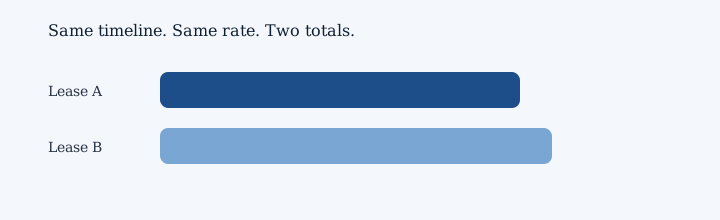
Sample NPV for the model path lease is about $358,483. A second path lands near $346,175. That gap is a talking point, not a promise.
A model starts when year one is complete. If one path wins only because a credit sat in the wrong year, start over.
Year notes for the model path lease
- Year 1 of the model path lease has rent of $38,800.
- Shared building cost is $9,600.
- A credit of $7,500 lowers the cash you pay that year.
- Cash out this year is about $40,900. A model starts when year one is complete.
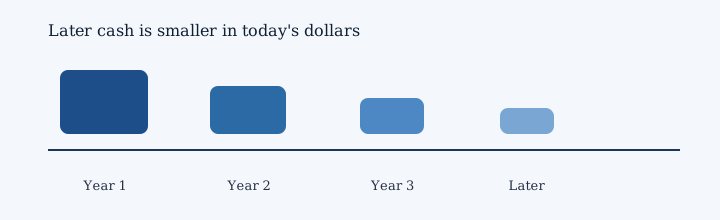
- Later cash gets a shrink for time. At 8 percent, year 1 is worth about $37,870 today.
- Next, year 2 rent is $39,964.
- CAM, which is a shared building cost, is $9,888.
- There is no credit in this year.
- You pay about $49,852 this year after extras and credits. Shared rules keep year two honest.
- Time shrinks later cash. At 8 percent, year 2 is worth about $42,740 today.
- Then year 3 rent is $41,163.
- Extras for the building come to $10,185.
- Credits skip this year.
- The net cash this year is about $51,348. The compare uses these later rows.
- Waiting has a price. At 8 percent, year 3 is worth about $40,762 today.
- After that, year 4 rent is $42,398.
- The shared building cost this time is $10,490.
- No extra credit shows up this year.
- Cash out this year is about $52,888. A test might change this year.
- Later cash gets a shrink for time. At 8 percent, year 4 is worth about $38,874 today.
- In year 5 of the model path lease, rent is $43,670.
- Shared building cost is $10,805.
- There is no credit in this year.
- You pay about $54,475 this year after extras and credits. The summary mentions this last year only if it matters.
- Time shrinks later cash. At 8 percent, year 5 is worth about $37,075 today.
- Year 6 of the model path lease has rent of $44,980.
- CAM, which is a shared building cost, is $11,129.
- Credits skip this year.
- The net cash this year is about $56,109. Keep this later year in the sum for the sample.
- Waiting has a price. At 8 percent, year 6 is worth about $35,358 today.
- Next, year 7 rent is $46,329.
- Extras for the building come to $11,463.
- No extra credit shows up this year.
- Cash out this year is about $57,792. The row still belongs in the sum for the long path.
- Later cash gets a shrink for time. At 8 percent, year 7 is worth about $33,721 today.
- Then year 8 rent is $47,719.
- The shared building cost this time is $11,807.
- There is no credit in this year.
- You pay about $59,526 this year after extras and credits. Keep this later year in the sum for the long path.
- Time shrinks later cash. At 8 percent, year 8 is worth about $32,160 today.
- After that, year 9 rent is $49,151.
- Shared building cost is $12,161.
- Credits skip this year.
- The net cash this year is about $61,312. The row still belongs in the sum for the long path.
- Waiting has a price. At 8 percent, year 9 is worth about $30,671 today.
- In year 10 of the model path lease, rent is $50,626.
- CAM, which is a shared building cost, is $12,526.
- No extra credit shows up this year.
- Cash out this year is about $63,152. Keep this later year in the sum for the long path.
- Later cash gets a shrink for time. At 8 percent, year 10 is worth about $29,252 today.
Add those year values. The sample NPV for the model path lease is about $358,483. This is a teaching sample, not a client result.
Questions this topic answers
These are the standalone authority pages in this family. They are grouped so a reader can start, calculate, compare, or go deeper without a wall of cards.
Calculate it
Common mistakes
For your role
Trusted sources
These are public references. They are not endorsements and not client results.